Portée par l’émotion suscitée par l’affaire Lyhanna, une vague de manifestations a déferlé samedi dans toute la France pour dénoncer les violences sexuelles et réclamer une « loi-cadre intégrale » sur le sujet. À l’appel de 180 associations féministes et de défense des enfants, des milliers de personnes, souvent venues en famille, ont défilé dans environ 110 villes. À Paris, la marche partie de la place de la Bastille pour rejoindre Nation a rassemblé 100 000 personnes selon les organisateurs, qui parlent d’une « mobilisation historique contre les violences sexuelles ». La préfecture de police a, elle, comptabilisé 6 440 manifestants dans la capitale.
En province, les organisateurs revendiquent également 110 rassemblements, de Nantes à Bordeaux en passant par Toulouse, pour un total de 10 700 participants d’après une source policière. À Rennes, 200 à 300 personnes se sont réunies dans la matinée. Parmi elles, François Rouillard, 43 ans, père de deux filles, dit souhaiter « un peu plus d’éducation au niveau de l’école » et, plus largement, que l’on parle davantage « du rapport hommes-femmes, du respect ». Dans les cortèges, les slogans ciblent à la fois la protection des mineurs et les moyens de l’État : « La vérité sort de la bouche des enfants », « 160 000 enfants, que faites-vous ? », « Darmanin, des moyens ! » résonnaient sur des musiques d’Angèle et Clara Luciani.
Au-delà de la démonstration de force, le cœur des revendications porte sur un changement de méthode législative. Les associations réunies exigent une loi « globale », et non plus des « mesures et des lois parcellaires, dictées par l’urgence d’affaires successives ». Elles appellent à un texte pensé « à 360 degrés » pour lutter contre les violences sexuelles, depuis la prévention et la formation jusqu’au traitement judiciaire et à l’accompagnement des victimes, en particulier les plus vulnérables. Dans les rangs des manifestants, certains dénoncent une justice « sous-dotée en moyens » et une prise en charge qui, selon eux, fait peser une forte charge sur les plaignants, comme en témoigne cette lycéenne de 17 ans racontant les difficultés rencontrées lors du dépôt de sa plainte pour viol.
La forte mobilisation place l’exécutif et le législateur sous pression alors que les critiques se multiplient sur la réponse institutionnelle aux violences sexuelles, notamment dans les écoles et au sein des familles. Des manifestants affirment être directement touchés par des agressions survenues dans les établissements de leurs enfants et pointent des responsables politiques accusés de « faire semblant de prendre des mesures ». Les organisateurs préviennent qu’ils ne se satisfont plus de réponses jugées fragmentaires et entendent maintenir la pression pour obtenir une loi-cadre intégrale, sans préciser de calendrier mais en faisant de cette journée une étape dans un rapport de force appelé à durer.
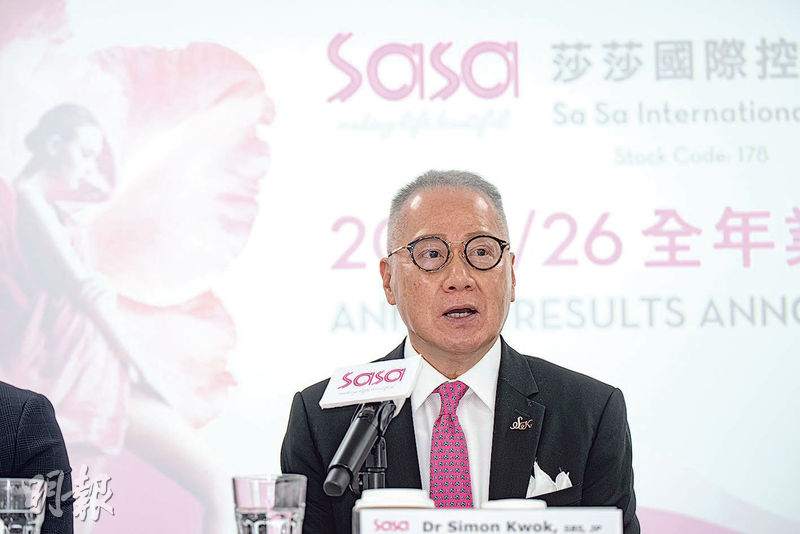
Sa Sa International Holdings Ltd. is ramping up store openings and restoring a full dividend payout after a sharp rebound in profit, underscoring management’s confidence in the recovery of Hong Kong and Macau’s beauty retail market. The cosmetics chain’s full-year sales rose 14.2% to HK$4.383 billion, while profit increased 1.6 times from a year earlier, allowing the group to boost its final dividend and return its payout ratio to 100%. Chairman and chief executive Simon Kwok said the stronger distribution reflects a “very strong” outlook, pointing to broad-based improvement in store traffic and spending.
Kwok said all key operating indicators in Hong Kong and Macau — including revenue, same-store sales, transaction volume, average ticket size and units per transaction — recorded year-on-year gains in the last financial year. Momentum has continued into the new year: in the first quarter of the current financial year, total revenue grew 24%, with offline sales up 30.9%. Hong Kong and Macau led with a 32.5% jump in offline sales, while Southeast Asia rose 17%. Online revenue slipped 3.2% overall, weighed by an 18.1% decline in mainland China, even as Hong Kong, Macau and Southeast Asia posted online growth.
On the back of the recovery, Sa Sa is reviving its brick‑and‑mortar expansion, particularly in tourist districts that were heavily rationalised during the downturn. The company plans to open 10 new stores in the current financial year; it has already added outlets in Mong Kok and Tsim Sha Tsui, including a large upstairs shop of about 6,000 to 7,000 square feet at the Mong Kok Man Wah Centre, on top of an existing ground‑floor unit. A store at the Airside mall in Kai Tak is slated to open in August, and another at Lok Ma Chau is planned to capture cross‑border traffic. Kwok said tourist‑area stores are now about half the number they once were, leaving “substantial room” to rebuild the network, though he stressed the group will not neglect local customers.
Store format will be a key part of the strategy. Kwok said he and his wife favour large outlets and that she has advocated opening flagship stores to serve both mainland and local shoppers in a more spacious, comfortable environment. Still, decisions between large and small formats will depend on rents and operating costs; smaller shops require less staff and investment. He said that while the opening of new outlets may “slightly” dilute same‑store sales metrics, the impact should be limited as long as locations and rental terms are carefully chosen. Footfall remains the main focus: “Only when there are people will there be revenue,” he said, adding that broader product assortment and competitive pricing should help underpin demand even as more drugstore and beauty chains enter the market.
Sa Sa also aims to stabilise and eventually grow its Southeast Asian operations, where the group ended the last financial year with 75 stores — 70 in Malaysia and five in Singapore. The region’s near‑term target is to achieve break‑even. Three of the five Singapore stores are already profitable, and Kwok said the company would consider opening more outlets there if suitable opportunities arise, noting that Singaporean sales growth was particularly strong in the second half of the year. The Malaysian business is described as stable, with management planning tighter cost control. Kwok played down concerns about competition from other travel destinations and cross‑border consumption trends, saying that Hong Kong remains convenient for many mainland visitors, some of whom come once or twice a month, and that the company’s breadth of products and pricing remain competitive.