Cebu’s New West Philippine Sea Holiday Draws Beijing’s Ire, Manila’s Support

05.07.2026


Philippine Defense Secretary Gilbert Teodoro Jr. intensified criticism of Beijing’s stance on the South China Sea, accusing China of “insincerity” and “duplicity” after the Chinese Embassy in Manila again rejected a 2016 arbitral ruling that invalidated the country’s expansive maritime claims. The clash underscores renewed diplomatic friction as the Philippines doubles down on the award from an international tribunal in The Hague, which it insists is “final and binding” and central to its position in the disputed waters known locally as the West Philippine Sea.

Teodoro said the Chinese Embassy’s response to a statement from the Department of Foreign Affairs offered a “window into the true intentions of the Chinese Communist Party in dealing with our country,” alleging the mission’s officials “amply personified” what he described as Beijing’s double-talk. He condemned what he called an “arrogant display of deceitful indignation,” arguing that China’s assertions were “no longer credible” and that this was why, in his words, Chinese officials were “resorting to ranting” and “agitation”. The Chinese Embassy, for its part, reiterated that it considers the 2016 arbitral award “null and void” and pointed to President Ferdinand Marcos Jr.’s repeated statements about managing differences with China to help ease tensions.

The sharpened rhetoric from Manila comes as the Department of National Defense throws its weight behind Cebu City’s move to declare July 12 as “West Philippine Sea Victory Day,” an annual commemoration of the arbitral ruling. In a statement released on June 29, Teodoro praised the Cebu City Council for unanimously approving the resolution, calling the 2016 decision “a victory which our country should embrace and fight to enforce.” The measure, authored by Councilor Paul Labra, not only institutionalizes the observance in Cebu but also urges Congress to establish a nationwide holiday marking the legal milestone.

Cebu’s initiative has drawn national attention, in part because of opposition from the Chinese Consulate General in the city and counter-arguments from Philippine maritime experts who have challenged Beijing’s protest over the resolution. The planned commemoration coincides with the 10th anniversary of the July 12, 2016 ruling, which invalidated China’s “nine-dash line” claim and affirmed the Philippines’ sovereign rights within its exclusive economic zone under the UN Convention on the Law of the Sea. While China continues to reject the award, Philippine officials say they will keep invoking it as they seek to protect what they describe as the country’s territorial interests in one of Asia’s most sensitive maritime flashpoints.
Hong Kong Secondary Prices Rise, Record Deal in Cheung Sha Wan Signals Firming Demand

05.07.2026


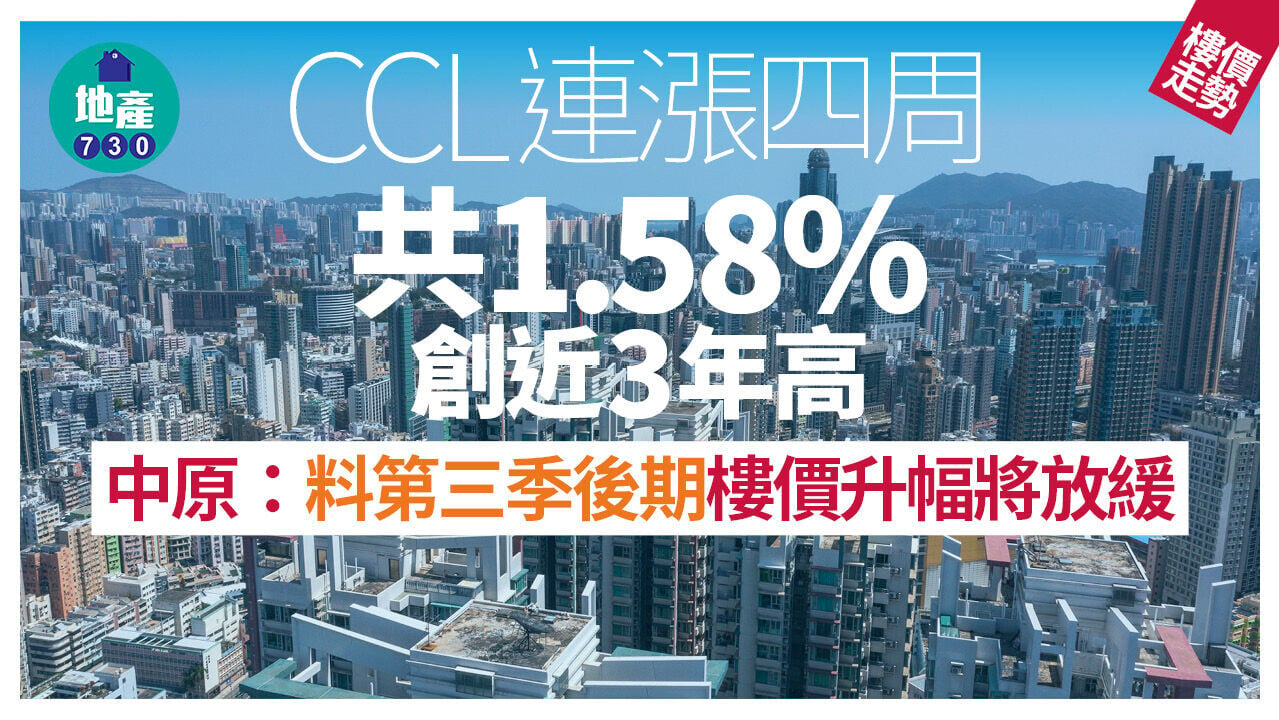
Hong Kong’s residential property market is extending a steady recovery, with key price gauges approaching levels last seen nearly three years ago, even as analysts warn momentum is likely to moderate in the coming quarter. The Centaline City Leading Index (CCL), which tracks secondary private home prices, rose for a fourth straight week to 159.94, up 0.57% on the week and 1.58% over the past month, marking its highest reading since around September 2023. The index has gained about 10.98% so far this year, underscoring a strong rebound in the second-hand segment.

Market data suggest the upswing is broad-based across different flat sizes, with larger units showing particular strength recently. Sub-indices for large housing estates and small-to-medium units advanced 0.61% and 0.43% respectively over the week, each climbing for a second consecutive week to near three-year highs. Prices of large units rose 1.25% in the latest week, extending a three-week gain of 3.01% to reach a two-and-a-half-year high. Regionally, Kowloon led with a 1.31% weekly rise to a near three-year high, while Hong Kong Island added 1.12% over the week and 2.34% across two weeks. New Territories East and West slipped 0.38% and 0.24%, ending their recent upward runs.

The official Rating and Valuation Department’s private home price index paints a similar picture of sustained recovery over a longer horizon. The index climbed 1.42% in the latest month to 321.9, its 12th consecutive monthly gain and a 12.36% increase from a year earlier. For the first five months of the year, official prices are up 7.44%. Still, both the CCL and the official gauge remain below their 2021 peaks: the CCL is about 16.41% under its August 2021 record of 191.34, while the government index is roughly 19.14% shy of its September 2021 high of 398.1, highlighting the distance yet to recover from the last cycle’s top.

Smaller units continue to outperform. Prices for A, B and C category flats — those up to 1,076 square feet — advanced 1.47% month on month and 12.57% year on year to 324.2 on the official scale, the highest level in about 32 months. Larger D and E category units of 1,076 square feet or more also rose, but at a slower clip, with their index up 1.17% on the month and 8.99% on the year to a roughly 31‑month high of 284.9. In the secondary market, sentiment is being reinforced by record-setting deals: at Yuet, a redevelopment project in Cheung Sha Wan near the MTR station, a one‑bedroom flat recently changed hands for HK$6.088 million, or HK$17,394 per square foot on a usable basis, the highest price per square foot recorded in the estate’s second-hand market. The seller, who bought in the first launch about two years ago, booked a paper gain of more than HK$870,000, illustrating improving prospects for recent purchasers.

That momentum, however, is colliding with a more uncertain macro backdrop and shifting financial conditions. Since late May, tightened action by mainland regulators against illegal cross-border investment has weighed on Hong Kong equities, with continued stock market weakness and slower first-hand project sales feeding into more protracted bargaining in the secondary segment. Concerns that the US may raise interest rates again have also contributed to a more cautious tone among buyers. Centaline analysts expect the pace of home-price gains to slow from the latter part of the third quarter, as the earlier surge gives way to more selective demand.

Financing dynamics are another source of restraint. According to industry commentary, an easing of tensions in the Middle East has coincided with capital outflows from Hong Kong, pushing interbank rates higher and reducing the scope for further cuts in mortgage costs in the near term. With prices having already rebounded, rental yields have edged lower, prompting some potential investors to reconsider the timing of their purchases. Even so, the leasing market remains firm: the official rental index reached 204.1 in the latest month, up 0.34% and notching its seventh straight advance to a record high, 5.1% above a year earlier and about 1.8% higher over the first five months of the year.

For now, the data point to a housing market that has clearly emerged from its recent trough but is still some distance from its historic highs, with gains increasingly vulnerable to shifts in global interest-rate expectations and equity-market sentiment. Developers face the added challenge of new supply from large-scale projects in coming years, which could divert some demand away from the secondary sector. With both price and rent indices on multi‑month winning streaks, the balance between affordability, financing costs and investment returns is likely to determine how durable Hong Kong’s latest property upswing proves to be.