Philippine authorities are moving to tighten legal and law-enforcement tools against a fast-evolving form of online radicalization they say is targeting children and teenagers, following the deadly June 22 school shooting in Tacloban City. The Philippine National Police (PNP) has sought assistance from foreign counterparts to trace an online extremist group known as “764,” which investigators believe may have influenced two minor suspects in the attack at San Jose National High School. PNP Chief Gen. Jose Melencio Nartatez Jr. said the force will work with law-enforcement agencies abroad to determine the group’s footprint and identify individuals behind it, as well as assess potential involvement of Filipinos and possible target victims.
The Tacloban shooting, which left three students dead, has sharpened focus in Manila on what officials and lawmakers describe as nihilistic violent extremism, or NVE. During a Senate inquiry into the incident, Senator Risa Hontiveros, who heads the chamber’s committee on women and children, said there were indications the campus attack could be linked to an “online nihilistic violent extremist” network infiltrating popular gaming platforms to brainwash vulnerable children. Senate President Sherwin Gatchalian cited what he described as a rise in reported cases of minor-inflicted violence and called for a dedicated law to counter NVE, including online grooming and the progressive “brainwashing” of youths into committing violent acts.
Justice Undersecretary Nicholas Felix Ty has outlined how NVE operates, describing it as a form of violent extremism in which children and young adults are manipulated—often on social media and gaming sites—into a sequence of increasingly serious offenses. According to Ty, behavior may start with relatively minor violations such as trespassing or vandalism before escalating into self-harm, animal cruelty and, in some instances, mass-casualty attacks. He said perpetrators exploit emotional vulnerabilities and the desire for acceptance, using those pressures to steer young people toward harmful conduct. In a previous case cited by Gatchalian, a gaming platform was linked to a planned school attack in Laguna in early 2026.
To confront these trends, the Department of Justice is advocating a comprehensive statute modeled on the Philippines’ existing anti-terrorism and anti-human trafficking laws. Ty said the DOJ is ready to work with Congress on a measure that would provide clearer legal bases to prosecute online grooming and exploitation tied to violent acts, while mobilizing a whole-of-government response involving law enforcement, education, and social welfare agencies. Pending such legislation, the department plans to recommend that the Anti-Terrorism Council adapt current counterterrorism mechanisms to address NVE, noting that similar approaches are being used in other countries. The council’s interagency structure, which already brings together the DOJ, Education and Social Welfare departments among others, offers a template that authorities say can be leveraged to strengthen intelligence gathering and coordination as lawmakers deliberate on a dedicated NVE law.
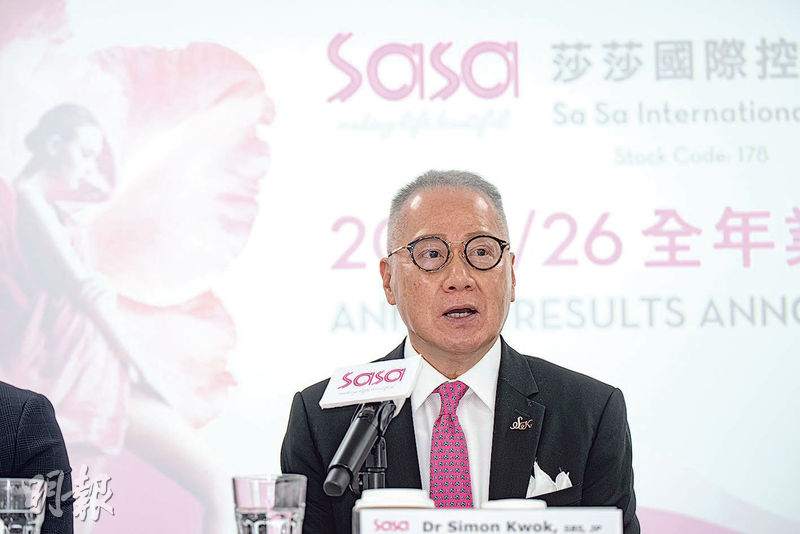
Sa Sa International Holdings Ltd. is ramping up store openings and restoring a full dividend payout after a sharp rebound in profit, underscoring management’s confidence in the recovery of Hong Kong and Macau’s beauty retail market. The cosmetics chain’s full-year sales rose 14.2% to HK$4.383 billion, while profit increased 1.6 times from a year earlier, allowing the group to boost its final dividend and return its payout ratio to 100%. Chairman and chief executive Simon Kwok said the stronger distribution reflects a “very strong” outlook, pointing to broad-based improvement in store traffic and spending.
Kwok said all key operating indicators in Hong Kong and Macau — including revenue, same-store sales, transaction volume, average ticket size and units per transaction — recorded year-on-year gains in the last financial year. Momentum has continued into the new year: in the first quarter of the current financial year, total revenue grew 24%, with offline sales up 30.9%. Hong Kong and Macau led with a 32.5% jump in offline sales, while Southeast Asia rose 17%. Online revenue slipped 3.2% overall, weighed by an 18.1% decline in mainland China, even as Hong Kong, Macau and Southeast Asia posted online growth.
On the back of the recovery, Sa Sa is reviving its brick‑and‑mortar expansion, particularly in tourist districts that were heavily rationalised during the downturn. The company plans to open 10 new stores in the current financial year; it has already added outlets in Mong Kok and Tsim Sha Tsui, including a large upstairs shop of about 6,000 to 7,000 square feet at the Mong Kok Man Wah Centre, on top of an existing ground‑floor unit. A store at the Airside mall in Kai Tak is slated to open in August, and another at Lok Ma Chau is planned to capture cross‑border traffic. Kwok said tourist‑area stores are now about half the number they once were, leaving “substantial room” to rebuild the network, though he stressed the group will not neglect local customers.
Store format will be a key part of the strategy. Kwok said he and his wife favour large outlets and that she has advocated opening flagship stores to serve both mainland and local shoppers in a more spacious, comfortable environment. Still, decisions between large and small formats will depend on rents and operating costs; smaller shops require less staff and investment. He said that while the opening of new outlets may “slightly” dilute same‑store sales metrics, the impact should be limited as long as locations and rental terms are carefully chosen. Footfall remains the main focus: “Only when there are people will there be revenue,” he said, adding that broader product assortment and competitive pricing should help underpin demand even as more drugstore and beauty chains enter the market.
Sa Sa also aims to stabilise and eventually grow its Southeast Asian operations, where the group ended the last financial year with 75 stores — 70 in Malaysia and five in Singapore. The region’s near‑term target is to achieve break‑even. Three of the five Singapore stores are already profitable, and Kwok said the company would consider opening more outlets there if suitable opportunities arise, noting that Singaporean sales growth was particularly strong in the second half of the year. The Malaysian business is described as stable, with management planning tighter cost control. Kwok played down concerns about competition from other travel destinations and cross‑border consumption trends, saying that Hong Kong remains convenient for many mainland visitors, some of whom come once or twice a month, and that the company’s breadth of products and pricing remain competitive.